New Player Guide: Turns, Combat, and Priority
Third post in the new player series, and the meatiest one. This is how a turn of Spirefall actually flows: the phases, how attacking and blocking work, and what the Pass Priority button really does.
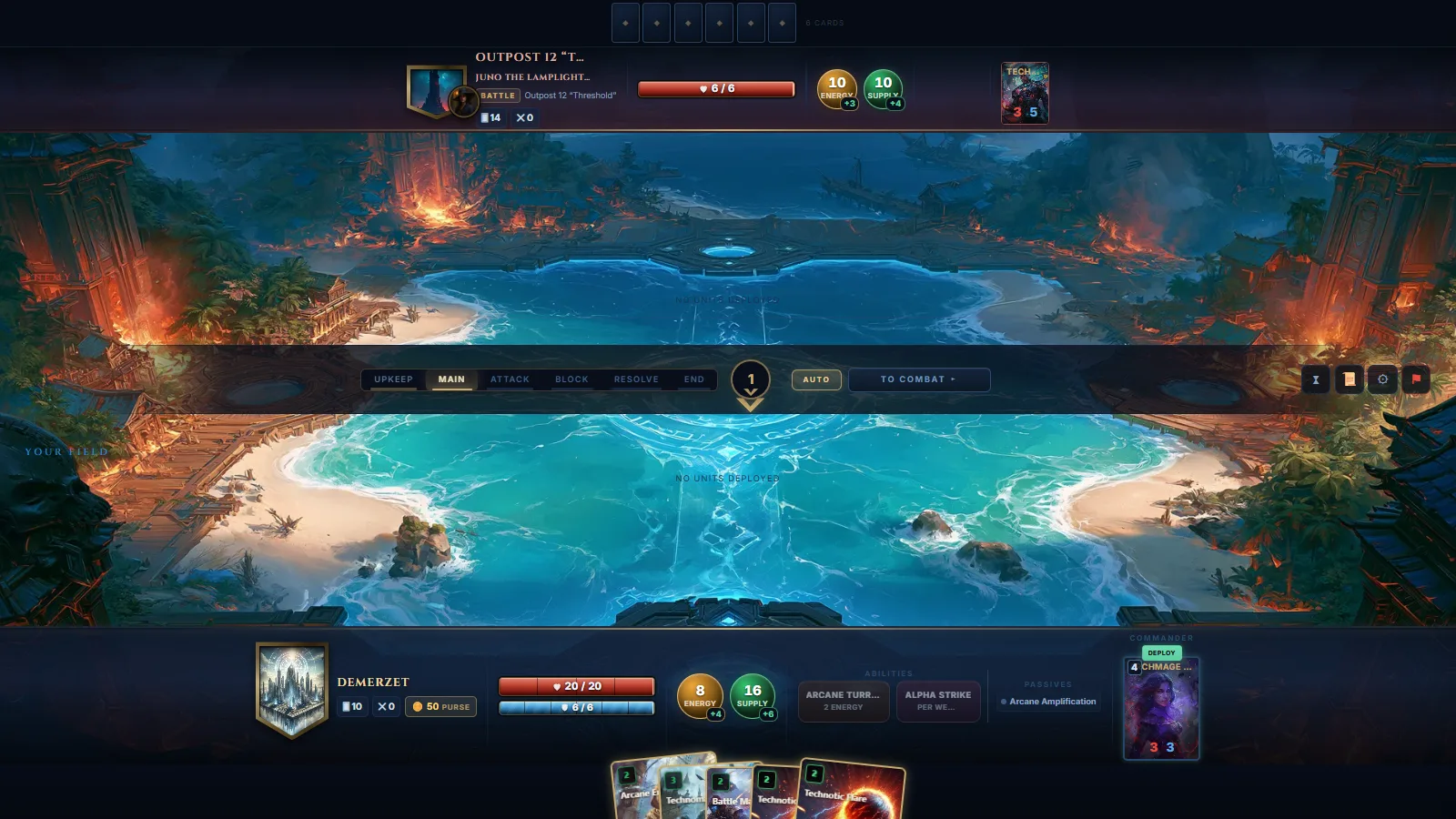
The phase strip
Every turn walks through the same phases, shown on the strip in the middle of the screen: Upkeep, Main, Attack, Block, Resolve, End.
Upkeep runs by itself, no input needed. Your tapped units untap, your fortress generates its income for the turn, you pay upkeep on anything that charges it, and you draw a card. One warning here: if you can't afford a unit's upkeep, it picks up fatigue, a permanent -1/-1 that stacks every turn you miss the payment. Don't deploy more than your income can feed.
Main is where most of your turn happens. Play units, lands, and spells, deploy your commander, fire your fortress abilities. When you're done, pass.
Attack is where you choose attackers. Attacks target the enemy fortress by default, not enemy units. Attackers tap when you confirm, which means they can't block on the way back, so every attack is also a small bet on defense. If you'd rather hold, skip combat entirely.
Block belongs to the defender. When you're attacked, you assign your untapped units as blockers, or take the hit. This is also a window where you can play Instant spells and Ambush units, so an attack into an open board isn't always as safe as it looks.
Resolve applies the damage, all at once. Then End gives both players one last chance to act before the turn passes over.
How damage works
Blocked attackers and their blockers hit each other simultaneously. Unblocked attackers hit the fortress. Fortress damage lands on the shield first, then hit points. A few keywords bend these rules, and they're the ones worth learning first:
- Toughness shaves 1 off every hit the unit takes.
- Penetrate ignores Toughness.
- Preemptive deals its damage first, so a big enough hit kills the blocker before it can swing back.
- Overwhelm pushes leftover damage through to the fortress.
- Stealth can't be blocked at all.
- Blitz lets a unit attack the same turn it arrives. Everyone else has to wait a turn.
Every keyword has a tooltip in game, so you never have to memorize them. These six just come up early and often.
Priority, or whose turn is it within the turn
The big green button in the center is the heart of the whole system. During Main and End, both players get a chance to act before the phase moves on. You act, then pass. Your opponent acts, or passes. When both players pass in a row, the game moves forward.
When someone plays a spell, it doesn't resolve immediately. It goes on the stack, and the other player gets a window to respond, usually with an Instant. Responses resolve in reverse order: last one played, first one resolved. That's how a Hold Up! cancels a spell: it goes on the stack on top of it and resolves first.
If all this passing sounds like busywork, there's an Auto toggle next to the button. It passes for you whenever you have no meaningful action, and stops the moment you do. Most players leave it on.
The button also renames itself to whatever it does right now: To Combat, Confirm Attackers, Confirm Blockers, Take the Hit, End Turn. When in doubt, read the button.
That's a full turn. The next post zooms out to the run around the battles: the map, the gold, and the Keeper at the end of it.